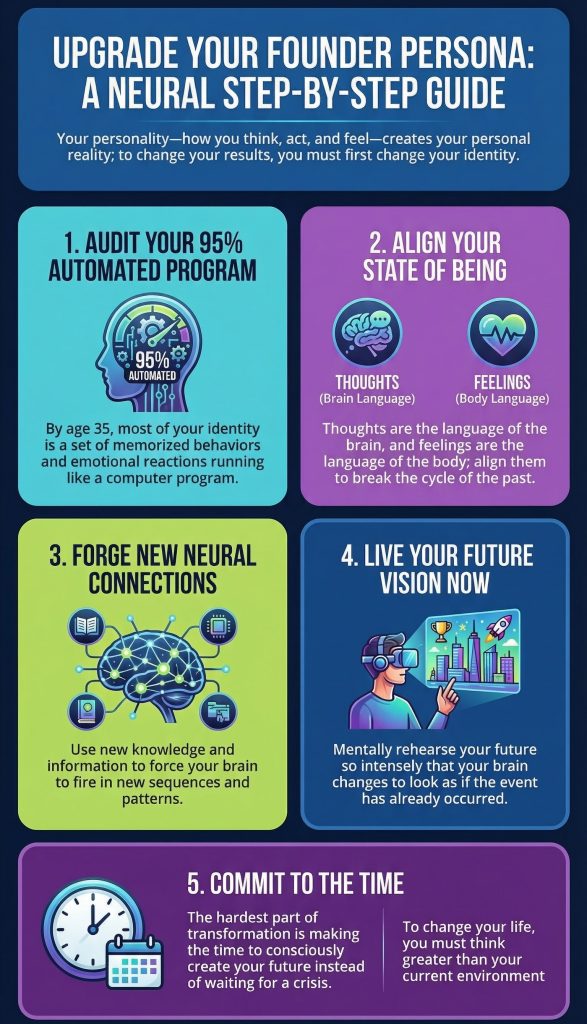
This post explores the connection between repetitive thoughts and the physical reality individuals experience daily. Most people live in a habitual loop, where their brain acts as a record of the past rather than a map for a new future. To truly transform one’s life, an individual must think greater than their environment and consciously recondition the body to align with a new state of being. By intentionally adopting new patterns of thought and emotion, a person can physically rewire their brain to reflect a future that has not yet occurred. Knowledge and consistent practice are the primary tools required to break free from self-limiting cycles. Encouraging the audience to choose personal growth through inspiration and joy rather than waiting for a crisis to force a change. Below are detailed steps.
1. Introduction: The “Groundhog Day” Paradox
Imagine standing in a room and, with total conviction, introducing yourself to a stranger as a “genius.” It feels uncomfortable, doesn’t it? That discomfort is the first hint of a biological prison. Most of us wake up on the same side of the bed, shut off the alarm with the same finger, and shuffle into the bathroom to look in the mirror not to see who we are becoming, but to remember who we’ve been.
We drink from the same mug, drive the same route, and react to the same people who push the same emotional buttons. We hurry home to check emails so we can hurry to bed, only to hurry through it all again tomorrow. This is the “Groundhog Day” paradox: we perform the same actions every day while secretly expecting our lives to change. But neuroscience is clear: your personality creates your personal reality. If your personality remains an automated loop of the past, your future is already a foregone conclusion.
2. Takeaway 1: Your Brain is an Artifact of the Past
Your brain is not a map of the future; it is a physical record of everything you have learned and experienced up to this moment. It is a biological archive.
Thinking Greater Than Your Environment When you wake up and follow a repetitive routine, your environment is actually controlling your thinking. To truly evolve is to think “greater than” your current circumstances. Every giant of history William Wallace, Mahatma Gandhi, Martin Luther King Jr., or Joan of Arc possessed a vision that they couldn’t see, smell, or taste. Yet, that vision was so alive in their minds that they began to live as if that reality was happening in the present. They were not victims of their environment; they were architects of a new one.
“Your brain is a record of your environment an artifact of your past.”
3. Takeaway 2: The 95% Rule When Your Body Becomes Your Mind
By the time we hit 35, we are essentially walking computer programs. Roughly 95% of who we are is a set of memorized behaviors, emotional reactions, and hardwired beliefs.
The Dream Board Delusion A habit is defined as a state where the body knows as well as the mind. This creates a civil war. Your 5% conscious mind wants to be wealthy or healthy you put up a “dream board” and try to think positively. But the other 95% of you, the subconscious body-mind, is conditioned for unworthiness or lack. You are a conscious mind in opposition with a body that has been programmed to stay the same. You cannot create a new personal reality while remaining the same personality.
4. Takeaway 3: The “Fire and Wire” Principle
The mechanism of transformation relies on a fundamental neurological law: nerve cells that fire together, wire together. If you repeat the same thoughts and actions, you forge a finite neurological signature a “box” in your brain of redundant programs.
Mind as the Brain in Action “Mind” is quite simply the brain in action. To change your mind is to force the brain to work in new sequences, patterns, and combinations. Knowledge is the catalyst. Every time you learn something new, you forge a new connection. Learning is the act of making those connections; remembering is the act of sustaining them. By feeding the brain new information, you break the old “fire and wire” loop and begin to build a new biological structure.
5. Takeaway 4: The Thinking-Feeling Loop
There is a chemical bridge between the head and the heart. Thoughts are the language of the brain; feelings are the language of the body. When you have a thought, the brain produces a chemical that makes you feel exactly how you were thinking.
The Addiction to the Self Once you feel that way, you begin to think the way you feel, which creates more chemicals to reinforce the feeling. This cycle creates a “state of being.” For most people, this loop is so redundant that they become addicted to their own unhappiness or stress.
“Then you think the way you feel and then you feel the way you think and then you feel the way you think… and some people do this for 20 or 30 or 40 years.”
6. Takeaway 5: The Quantum Requirement
The “Quantum Field” the universal intelligence that governs reality does not respond to what you want. It responds to who you are being.
The Language of Alignment If you are thinking of wealth (brain) but feeling poor (body), you are sending a mixed signal to the field. Positive thinking fails because it’s just a surface-level thought that hasn’t moved the body. The Quantum Field only responds when the mind and body are aligned. You must feel the gratitude of the future event before it happens; you must condition the body to a new mind until the body believes the future reality is occurring now.
7. Takeaway 6: The Choice Between Crisis and Inspiration
Humanity has a tragic habit of waiting for a “crisis model” of change. We wait for the trauma, the diagnosis, or the loss that brings the ego so low that we can no longer continue business as usual.
Breaking the Neurochemical Order We insist on a specific neurochemical order an addiction to our suffering until we are forced to change by external pain. But we have a choice. We can examine our thoughts and behaviors in the shadows of suffering, or we can evolve in a state of joy.
“My message is why wait? We can learn and change in a state of pain and suffering… or we can learn and change in a state of joy and inspiration.”
8. Conclusion: The Hardest Part of Transformation
The goal of this work is to change the brain so profoundly that it physically looks as if the future you desire has already happened. Science confirms that through mental rehearsal and intentional focus, we can install the neurological hardware to prepare for a new experience.
However, the greatest obstacle isn’t the science it’s the schedule. The hardest part of transformation is making the time to do it. It is the act of stepping out of the automated computer program to invest in your “precious self.”
Are you willing to silence the routine, look past the known, and make time to create a future that you cannot yet see, but can entirely imagine?
In conclusion, we at Smart Group hope this article has provided you with valuable insights and actionable strategies. Smart Group India Incubation provides a nurturing environment for startups, offering comprehensive support and resources to foster growth and innovation. With access to expert mentorship, state-of-the-art infrastructure, and networking opportunities, startups can thrive in their journey from ideation to market launch. Explore our services in DevOps consultancy, IoT solutions, and cybersecurity to leverage cutting-edge technology for your business success. Join us to embark on a transformative journey towards entrepreneurial excellence. For further information and a deeper dive into this topic, we encourage you to explore the following resources. These links offer a wealth of knowledge and expert opinions that can enhance your understanding and assist you in applying these concepts effectively.
Startup Policies Govt. Of India
Startup News Sites
Publications
Research Papers